Tuesday, December 17, 2013

The Next Disruption: Session Recap


In March 2013, Bonnie Cain-Wood attended a session on disruptive technology. Her notes, take aways and follow up questions are below.

Session Brief: James McQuivey, Ph.D., author of the new book “Digital Disruption,” promotes that accelerated disruption is made possible by ubiquitous digital platforms and tools. He has observed the rise of a mindset among digital disruptors that is part hacker ethic, part rugged individualist, and part naive do-gooder.

These traits are converging in maximally disruptive individuals who McQuivey collectively calls The Next Disruption. Where digital disruption research has historically focused on rewriting the rules of business, The Next Disruption will go further, consciously applying the same interest in experimentation, data science, and risk to change the way we learn, govern, and live. This is not about the next big thing. It's about the next small things, billions of them, moving toward a bigger future than any powerful players can do alone.

Tuesday, December 10, 2013

Sir Ken Robinson: Killing Creativity


What do we do that stifles creativity? What could we do better to foster creativity?

Tuesday, December 3, 2013

Rise of the Autodidadic Degree: Session Recap


In March 2013, Bonnie Cain-Wood attended a session on disillusion with college educations. Her notes, take aways and follow up questions are below.

Session Brief:  People are realizing the financial burden of student loans and the struggle to find a job after graduation. Meanwhile, their role models are both some of the most successful people in business AND college dropouts — Steve Jobs, Mark Zuckerberg and Bill Gates, to name a few. We’re entering a new reality, where education and opportunity are what you create. This means thousands upon thousands of people are asking the same question, “Is a college degree really worth the money or can I get the same information and training for free online and through other mechanisms?” It’s a defining time for universities, students, graduates and businesses. This session explored what this shift means and how both businesses and education systems should react.

Take Aways:
·         Era of Innovation introduce new forms of education. 
·         Today we see an increase in self-education. Why:
1. We question the value of a college degree. 
2. Connectivity and Information (ex: MOOC)
3. Human nature-we want to learn, we are curious

Library Applications:
·         As an academic institution are we afraid of the rise of the "autodidadic degree"? Should we be?
·         What do we do to give our students the information literacy skills to be robust self-learners?
·         In our hiring, promotion, training, etc. what can we do to identify, recognize and give credit for self-education?

If you would like to share your notes on conference sessions relevant to the Library Future Series contact lib-pub@okstate.edu.

Tuesday, November 26, 2013

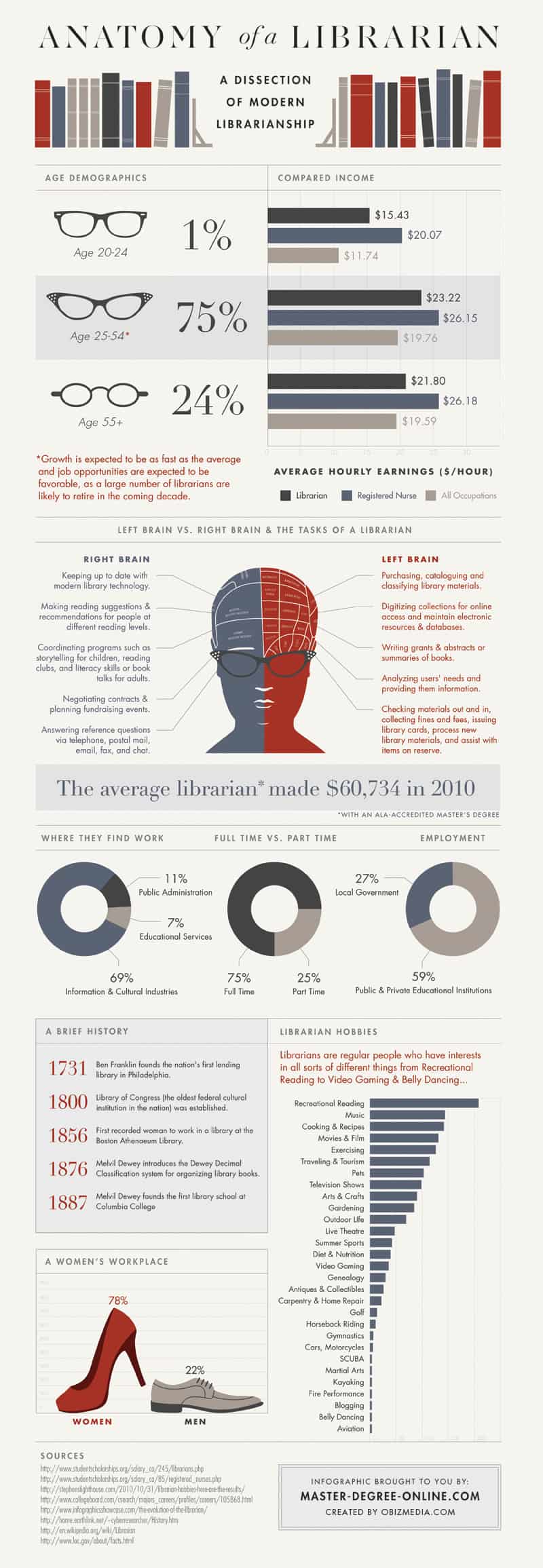
Anatomy of a Librarian


What brought you to a career in libraries?


Tuesday, November 12, 2013

Dan Pink: The Puzzle of Motivation

How do we motivate employees? What else could we be doing to motivate employees?


Wednesday, November 6, 2013

Yes to the Mess, Leadership Lessons from Jazz: Session Recap


In March 2013, Bonnie Cain-Wood attended a session on improvisation and leadership. Her notes, takeaways and follow up questions are below.

Session Brief: An improvisational mindset is important to a musician. If they listen carefully they can change their notes, invent something new, and adapt to changing rhythms and melodies. That same mindset is important in business.

Frank J. Barrett, jazz pianist and management scholar, says this improvisational “jazz mindset” – and the skills and competencies that go along with it—is crucial for effective leadership. Like skilled jazz musicians, organizations must take this inventive approach to successfully deal with issues that range from crisis management to spontaneous decision making to unforeseen new realities.


Takeaways:
·         Learn-then-execute model doesn't work for everything. Radical receptivity. Take it, learn and do all in real time. 
·         When you're lost, any map will do. Belief and hope give you confidence. A strategic plan isn't accurate; it is valuable because it gives you confidence in a common ground and that allows you all to move forward and learn as you go. 
·         To live in the moment, unlearn your patterns, interrupt habits and question routines. Throw yourself into the terror and go. 
·         Provocative confidence-throw people in over their head, provoke them to act. They will not like you at the time.

Library Applications:
·         Are we developing a plan that gives confidence to act?
·         We embrace a learn as we do mentality in our training phase. Do we force/encourage a learn as we do mentality in the innovation phase? 

Suggested Readings: “Yes to the Mess: Surprising Leadership Lessons from Jazz”

If you would like to share your notes on conference sessions relevant to the Library Future Series contact lib-pub@okstate.edu.

Monday, October 28, 2013

Project Information Literacy


PIL asked more than 11,000 college students important questions about being a college student in the digital age. Read a summary of their study (link “their study” to http://www.ala.org/acrl/sites/ala.org.acrl/files/content/conferences/confsandpreconfs/2013/papers/Head_Project.pdf).


What do we/can we do to assist students with the information literacy demands of the digital age?